



News & Information
While the shape of grilling grills may seem like a mere design difference, it actually directly impacts grill compatibility and user experience. Commonly available round and square grills perform very differently in different scenarios—round grills may be more suitable for heat distribution in charcoal grills, while square grills offer advantages in built-in grills. A thorough understanding of the differences in compatibility, ease of use, and space utilization is crucial for matching grilling tools to your specific needs.
1. Oven adaptability: shape determines "compatibility"
The shape and structure of the oven are the primary basis for selecting the mesh, and the matching degree between the two directly affects the heat utilization and safety performance.
Round grilling mesh is designed for use with traditional charcoal grills. These grills typically have round hearths (such as Korean charcoal grills and portable outdoor grills), typically ranging in diameter from 30-50cm. The edges of the round mesh seamlessly conform to the curve of the oven, preventing food from falling through gaps. The center of the mesh aligns with the hottest charcoal fire, creating a gradient heating pattern with a "hot center and cool edges"—ideal for grilling ingredients that require even heating, such as whole chicken wings or thick-cut steaks. Furthermore, the round mesh eliminates overhanging corners in a round grill, ensuring more even load-bearing performance and reducing the risk of deformation under high temperatures.
Square grilling mesh is standard equipment in modern electric and gas grills. Most home built-in grills and commercial stainless steel grills feature a square design, with oven chamber dimensions typically measuring 40cm x 60cm or 50cm x 70cm. Square mesh fully utilizes the oven's interior, with edges fitting snugly against the walls to prevent heat loss from corners. Especially in tiered grills, the square mesh's right-angled design allows for precise alignment with the oven's slots, providing enhanced stability and preventing shaking when turning ingredients. However, be aware that if square mesh is used in a round oven, the corners will extend beyond the oven's edges, wasting space and potentially causing the edges to sag due to uneven pressure.
In specific scenarios, shape adaptability is even more critical. For example, a folding grill commonly used for outdoor camping can use a square grill frame to avoid wasting space when stored. However, the round hearth of a traditional clay grill (such as a Mexican taco grill) can only use a round grill of the same size, otherwise it will disrupt the heat circulation inside the grill.
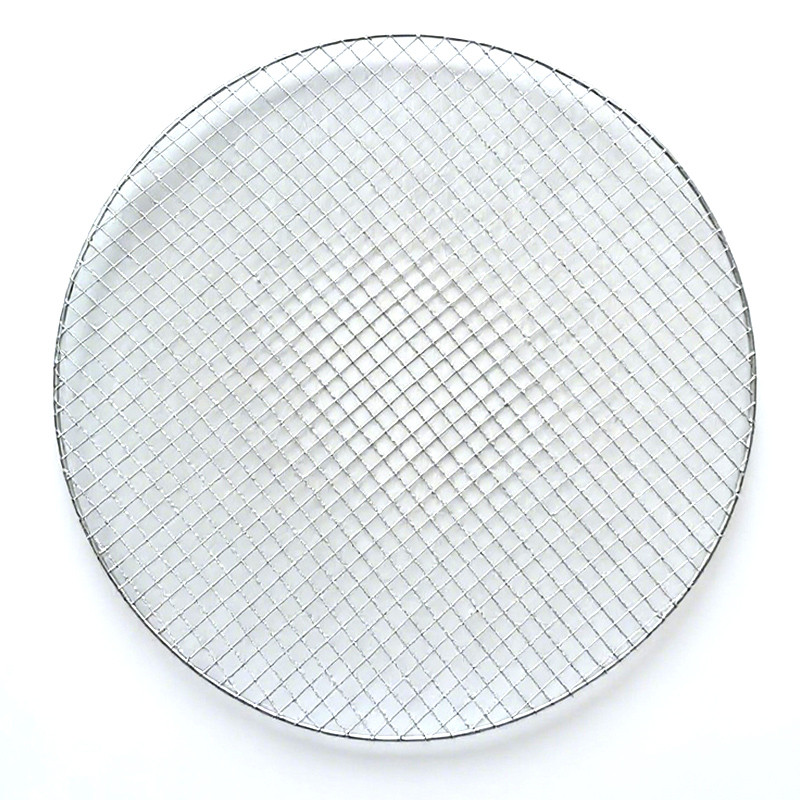
2. User Experience: Differences from Operation to Taste
The influence of shape on the grilling process is reflected in three dimensions: ease of operation, space utilization, and the grilling effect of ingredients.
In terms of ease of operation, round mesh is more suitable for single-person operation. Since there are no corner restrictions, it can rotate 360° freely when flipped, allowing ingredients to be evenly heated without adjusting the direction. It is especially suitable for grilling long ingredients (such as sausages and corn). Some round meshes are designed with symmetrical handles, which are balanced when held with both hands. Transferring the mesh (such as moving it from the oven to the dining table) is more stable and less likely to cause burns. The advantage of square mesh lies in multi-person collaboration scenarios. For example, in a barbecue restaurant, the chef can divide the area according to the right angles of the mesh and grill different ingredients separately (such as grilling seafood in the upper left corner and grilling skewers in the lower right corner). The division of labor is clear and it is not easy to get confused. However, the corners of the square mesh are sharp, so care should be taken to avoid bumps when operating.
Square mesh performs better in terms of space utilization. Given the same oven area, square mesh offers 15%-20% more effective usable area than round mesh. For example, a 40cm x 40cm square mesh has an area of 1600cm², while a 40cm diameter round mesh has an area of approximately 1256cm². The square mesh can accommodate 5-6 more skewers. This advantage is particularly evident in large gatherings or commercial settings, reducing batches and improving efficiency. However, the curved edges of round mesh are more suitable for grilling round ingredients (such as pizzas and flatbreads), preventing corners from falling over the mesh.
The difference in grilling results stems from heat distribution. Round grills, with their higher center temperature, are ideal for ingredients that require focused heating. For example, when roasting a whole chicken, the body can be placed in the center to quickly lock in the juices. The cooler edges allow vegetables (such as bell peppers and mushrooms) to be roasted simultaneously, preventing them from burning. Square grills, especially in electric ovens, distribute heat more evenly, making them ideal for applications that require a large, flat surface, such as chicken wings or fish fillets. When the ingredients are spread out flat, they receive uniform heat, preventing any overcooking.
The cleaning and storage experience also varies depending on the shape. Round mesh sheets have no blind spots and can be placed directly into a round sink for cleaning, with the brush smoothly following the curve. However, when stored in a square space (such as a cabinet), this wastes corner space. While square mesh sheets require cleaning from the corners, they can be neatly stacked in a square storage box, making them particularly suitable for bulk storage in commercial settings.
3. Synergy between material and shape
The combination of material and shape further amplifies the difference in user experience. For example, a round stainless steel mesh, due to its toughness and lack of stress concentration at corners, resists deformation after repeated use. However, a round wire mesh with a diameter exceeding 50cm tends to sag in the middle and requires a support bracket to support the weight. A square mesh made of thickened stainless steel has a stronger load-bearing capacity at right angles, making it suitable for placing heavy objects (such as a whole roasted leg of lamb). However, the welded corners of a square wire mesh are prone to breakage due to excessive stress, so avoid loading it with loads exceeding 2kg.
In terms of cost, square mesh of the same material and size is slightly more expensive than round mesh by 5%-10%. This is because square mesh requires more precise cutting (to avoid burrs on corners), while round mesh can be mass-produced through die stamping, resulting in lower costs. However, over the long term, the square mesh's greater spatial utilization reduces food waste, indirectly saving costs.
4. Scenario-based Selection Suggestions
For daily barbecue at home, if you use a round charcoal grill, it is preferred to choose a round stainless steel mesh with a diameter of 35-45cm, which takes into account both ease of operation and heating efficiency;
For large gatherings or commercial use, it is recommended to use a 50cm x 70cm thickened square mesh with a square electric or gas grill to improve space utilization.
Outdoor camping requires portability. Folding square mesh is more suitable for storage, while round mesh with mini charcoal stove is suitable for small gatherings of 1-2 people.
When grilling specific ingredients, the round mesh is suitable for round pizzas, whole chickens, etc., while the square mesh is suitable for skewers and vegetable platters grilled in different areas.
In short, the key to choosing between round and square grilling mesh is to find the perfect fit for your oven, the intended use, and the type of ingredients. There's no absolute superiority or inferiority, only compatibility—choosing the right shape will ensure a smoother grilling experience and more delicious food.

Leave us a message