



News & Information
In the evolution of grilling tools, handle-equipped grill grates have gradually replaced traditional handleless designs, becoming the preferred choice for both household and commercial use. This seemingly simple structural upgrade actually addresses multiple pain points in the grilling process—from operational convenience to safety protection—comprehensively enhancing the user experience.
Effortless operation is the most visible advantage of handle-equipped grill grates. Traditional grates require tongs to flip edges during use, which is not only labor-intensive but also risks uneven force causing food slippage. The handle design optimizes force distribution by relocating the grip from the grate edge to a dedicated ergonomic structure. Take common double-handle rectangular grates as an example: symmetrically positioned handles create balanced pivot points, allowing single-handed 180-degree flipping—ideal for whole fish or large cuts like chicken breasts. Circular grates feature contoured handles engineered with biomechanics for better palm contact and precise angle control during rotation, preventing food dislodgement.
Safety improvements are equally significant. Handleless grates require hands to be 20-30cm from heat sources, exposing users to radiant heat and oil splatter burns. Handle-equipped designs increase this distance to over 40cm, incorporating thermal barriers like high-temperature silicone sleeves to block heat transfer. Tests show that after 30 minutes on a 200°C grill, premium handle-equipped grates maintain grip-end temperatures below 50°C—well within human tolerance thresholds. Rounded handle edges and anti-slip textures further reduce operational risks, making them particularly suitable for children and beginners.
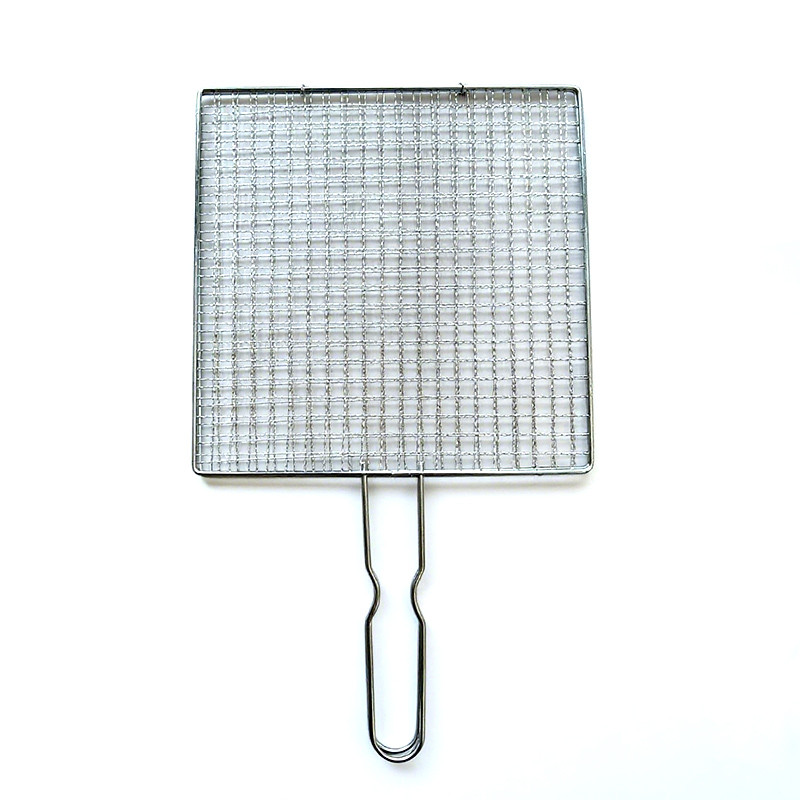
Space efficiency is another standout feature. Modern handle-equipped grates often feature foldable designs—handles can rotate flush against the grate surface when stored, reducing volume by 30%+ compared to traditional models. Some commercial-grade versions even fold semicircular grates into backpack-friendly half-circles. For commercial kitchens, hook-equipped handles enable vertical wall mounting, saving counter space while promoting natural drying to prevent rust.
Multifunctional adaptability expands usage scenarios. Home users can effortlessly transfer grates from grill to table using handles, eliminating serving tray steps.
Durability-wise, handle-equipped grates employ laser-welded joints with 5x stronger stress resistance than spot welds, enduring repeated flipping. Stainless steel handles with anti-corrosion coatings maintain performance in humid outdoor environments, extending lifespan by 2-3 years over standard grates.
This seemingly simple handle design represents deep optimization of grilling scenarios. Beyond solving operational pain points, its nuanced innovations elevate tool functionality and safety—making handle-equipped grill grates the intelligent choice for modern households prioritizing convenience or commercial operations requiring standardized protocols.

Leave us a message